When Is a Kitchen Too Damaged to Respray? Honest Warning Signs
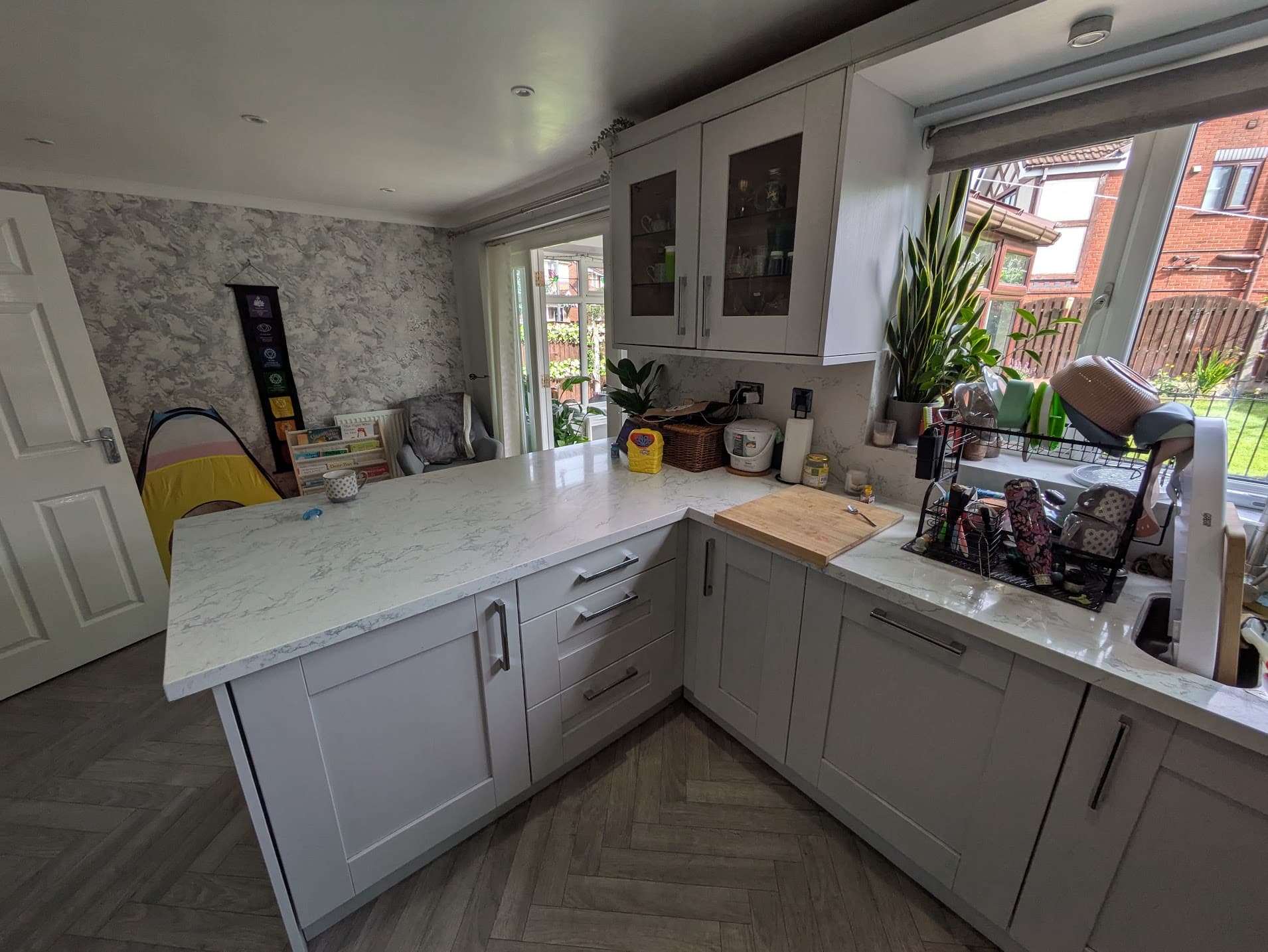
A kitchen is not automatically too damaged to respray because it looks dated, yellowed, chipped or tired. Bryan's first question is whether the bones are still good: solid carcasses, a layout the customer still likes, and doors that can be made stable enough for a proper finish.
The honest line is this: many kitchens that look past it can still be refurbished. But some doors have failed underneath. When swollen MDF, blown edges, split shaker trim or failed foil has gone too far, replacing the worst doors is often better than selling a respray that will not give the finish the customer expects.
Quick answer: how damaged is too damaged?
Too damaged usually means the material underneath the surface is no longer sound. If a door is flat, stable and only cosmetically worn, it can often be prepared and sprayed properly. If water has got into the MDF, the edges have blown, or the shaker trim has split away, that door may not be a good candidate anymore.
That does not mean the whole kitchen is finished. Bryan's approach is to separate the kitchen into parts: carcasses, layout, doors, panels, wet areas and finish. A few failed doors can sometimes be replaced while the rest of the kitchen is restored.
What “too damaged” actually means
Homeowners often judge the whole kitchen from the visible finish. Cream has gone yellow. Gloss looks dated. Handles are tired. Dark wood feels heavy. Those are usually aesthetic problems, not structural ones.
The bigger issue is failed substrate. If vinyl, foil or paper veneer is hiding MDF that has swollen, split or broken down underneath, spraying over the surface is not a proper fix. The finish is only as good as the material it is bonded to.
That is why Revitalize will not give a blanket yes from the brand name or age of the kitchen. A strong older kitchen can be a brilliant respray candidate. A newer-looking door with failed edges can be the one that needs changing.
Warning signs Bryan checks first
The most important checks are around the areas that take heat, steam, water and daily use. Sinks, dishwashers, kettles, bins, end panels and high-touch doors usually show the truth first.
- Badly swollen MDF around door edges or corners.
- Blown edges where the material has expanded or split.
- Shaker-style trim that has swollen, cracked or lifted away.
- Vinyl wrap, foil or paper veneer peeling across multiple doors.
- Water damage around sinks, dishwashers, kettles and wet zones.
- Doors that are warped, soft, crumbling or not sitting correctly.
- Cheap doors where the repair labour would not make commercial sense.
The key point is not to hide those problems. Clear damage photos help Revitalize choose the right route before any quote is given.
When a damaged-looking kitchen is still worth saving
A kitchen can look tired and still be a good candidate. If the carcasses are strong, the layout works and most of the doors are stable, a professional respray can make more sense than ripping out a kitchen that still has years of use left in it.
This is common with Howdens and Wren kitchens, but it can also apply to Wickes, Magnet, B&Q and IKEA kitchens when the substrate and condition are right. The badge helps less than people think. The condition decides.
In Bryan's words, the customer often does not need a new kitchen. They need the doors taking back properly, repairing, preparing and refinishing with the right process.
When replacement doors are the more honest answer
The main time Bryan recommends replacement doors is when the door itself has gone too far. It happens a lot with shaker-style doors where the trim has completely swollen, split or broken out of the vinyl or paper veneer.
Once water has got into those edges and the trim has blown, Revitalize is not restoring a solid door anymore. It is trying to rescue something that has failed underneath. In that case, replacing the failed doors is usually better than spending labour trying to make damaged material look perfect.
That still does not have to mean a full rip-out. If the carcasses are strong and the layout works, the smarter route may be to replace the bad doors, keep the structure and respray the kitchen properly.
Photos to send before deciding
Do not self-diagnose from the kitchen brand or one damaged corner. Send photos and let Revitalize assess the full picture. The best photos show the whole kitchen and the worst details.
- Two or three full-room photos from different angles.
- Close-ups of door edges, corners, drawer fronts and shaker trim.
- Sink, dishwasher, kettle and wet-area close-ups.
- Any peeling vinyl, foil failure, paper veneer failure or lifting.
- Any swollen MDF, blown edges, split corners or warped doors.
- End panels, island panels, plinths, handles and hinges if relevant.
Those photos help Revitalize decide whether the job is a straightforward respray, a deeper restoration, a replace-the-worst-doors route, or a case where the customer is better not spending money on that kitchen.
Cost and route options
Revitalize's public kitchen respray bands are £999–£1,500 for a Standard respray and £1,650–£3,500 for a Premium workshop-based respray. Those figures are useful guide rails, not a blind promise for a damaged kitchen.
If doors need repairing, replacing or deeper preparation, the final quote depends on door count, panels, condition and the finish required. Revitalize would rather price that honestly than pretend failed doors can be sprayed like sound ones.
For homeowners in Manchester, Stockport, Tameside, Cheshire and the North West, the practical next step is simple: send the photos first. If the kitchen has good bones, there is often a route that avoids the mess, delay and cost of a full replacement.
Ready for a free quote?
Take our 30-second quiz at revitalizeresprays.co.uk/quote — upload a few photos of your kitchen and we'll come back to you within 24 hours with a fixed price.
Or call Bryan directly on 07384 574225 — straight through to the workshop, no call centre, no chasing.
Revitalize Resprays — Unit 1a, 88-90 Wilton Street, Denton, Manchester M34 3NH. 25+ years wood-finishing experience, Google reviews from real local customers, as featured in The Times.
Frequently asked questions
When is a kitchen too damaged to respray?
A kitchen is usually too damaged to respray when the door substrate has failed: badly swollen MDF, blown edges, split shaker trim, failed foil or paper veneer, or water-damaged doors that cannot be made stable. Even then, the carcasses may still be worth keeping with replacement doors.
Can swollen MDF kitchen doors be sprayed?
Light swelling may be assessed, repaired or isolated depending on the door, but badly blown MDF is a warning sign. Once water has got into the edges and the door has failed underneath, replacing that door is often more honest than trying to spray it.
Does a damaged door mean I need a whole new kitchen?
No. Bryan's usual advice is to separate the door condition from the carcass condition. If the carcasses are strong and the layout still works, replacing failed doors and respraying the kitchen can be a better route than a full rip-out.
What photos should I send if I think my kitchen is too damaged?
Send full-room photos, close-ups of door edges and corners, wet areas around sinks and dishwashers, damaged shaker trim, peeling vinyl or foil, swollen MDF, end panels, islands and any doors you are worried about.
How much does it cost if repairs or replacement doors are needed?
Revitalize's public price bands remain Standard respray £999–£1,500 and Premium workshop-based respray £1,650–£3,500. Repairs, replacement doors, door count and condition can change the final quote, so photos are needed before pricing confidently.
Related reading

Bryan Grime
Founder, Revitalize Resprays
More from the blog
Vinyl Wrap, Foil Doors and Swollen MDF: Can They Be Sprayed?
Find out when vinyl wrap, foil kitchen doors and swollen MDF can be resprayed, when replacement doors are more honest, and what photos Revitalize needs first.
Kitchen ResprayingWhich Kitchen Brands Can Be Resprayed? Howdens, Wren, B&Q, IKEA, Wickes & Magnet
Find out which kitchen brands respray well, including Howdens, Wren, B&Q, IKEA, Wickes and Magnet, and when vinyl, foil or swollen MDF means replacement doors are better.
Kitchen ResprayingCan You Respray a B&Q or IKEA Kitchen? What to Check First
Find out when B&Q and IKEA kitchens can be resprayed, what Revitalize checks first, typical costs, and when replacement doors are the more honest route.
Kitchen ResprayingKitchen Respray or Replacement: Which Fits Your Kitchen?
Compare a kitchen respray with replacement by checking layout, storage, carcass condition, door damage, appliance changes and the finish you want.