Vinyl Wrap, Foil Doors and Swollen MDF: Can They Be Sprayed?
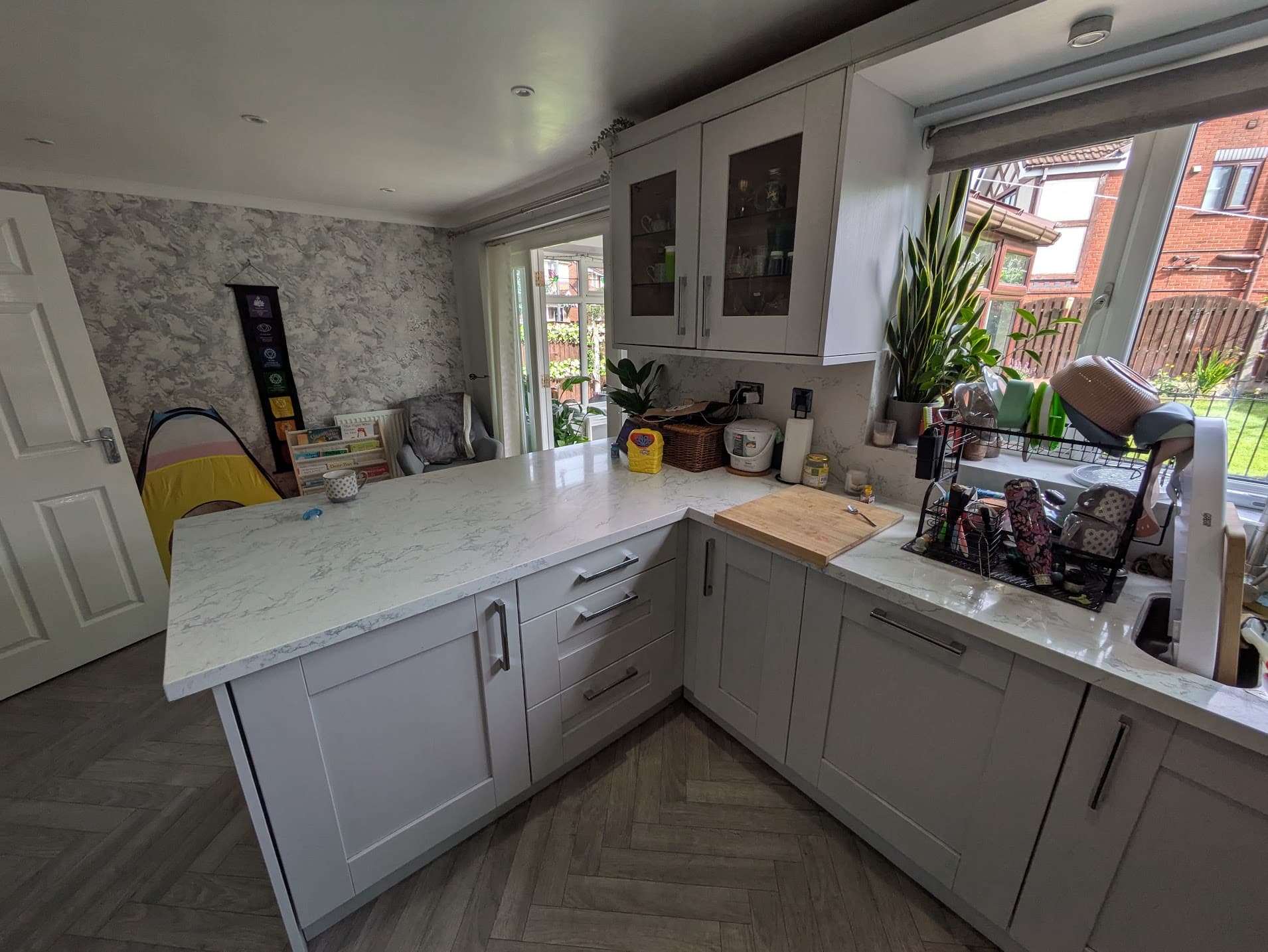
Vinyl wrap, foil doors and swollen MDF are three of the biggest reasons homeowners think their kitchen is past saving. Sometimes they are right. Often they are not. Bryan's view is condition-first: the badge and age matter less than whether the doors, edges, carcasses and substrate are still sound.
The honest answer is not “yes, everything can be sprayed” or “no, you need a new kitchen.” The honest answer is: send clear photos, check the failure points, then decide whether the right route is respray, repair, replacement doors, or walking away from a door that has gone too far.
Quick answer: can vinyl, foil or swollen MDF doors be sprayed?
Yes — but only after a proper assessment. If the door is still solid, the edges have not blown badly and the carcass is worth keeping, a professional respray or deeper refurbishment can make sense.
If the surface has failed underneath, that is different. Spraying over loose vinyl, failed foil, paper veneer or swollen MDF is not a proper fix. It may look better briefly, but the weak material underneath is still the problem.
This is why Revitalize checks photos before giving confident advice. A kitchen with a few tired doors may be a good refurbishment candidate. A kitchen with badly swollen shaker trim around wet areas may need some doors replacing first.
Vinyl wrap, foil doors and swollen MDF are not all the same problem
Homeowners often use the same words for different failures: “the paint is peeling”, “the laminate is coming off”, “the door has bubbled”, or “the edge has blown.” The right repair depends on what has actually failed.
- Vinyl wrap is a decorative skin over an MDF door. If the MDF underneath is sound, the failed skin can often be dealt with before refinishing.
- Foil or paper veneer can be more hit-and-miss. If it is lifting, splitting or water-damaged, the substrate needs checking before anyone promises a finish.
- Swollen MDF means water has got into the material. If the swelling is bad, the door itself may have failed rather than just the finish.
The brand does not decide it on its own. Howdens, Wren, B&Q, IKEA, Wickes and Magnet kitchens can all have doors that are either worth refurbishing or too far gone. Condition beats the badge.
When these doors can usually be sprayed or refurbished
A kitchen is a stronger candidate when the carcasses are still solid, the layout still works for the homeowner and the damage is mainly surface-level rather than structural. That is the common situation Bryan sees: the kitchen feels dated or tired, but the bones are still good.
Good signs include doors that are still flat, hinges that hold properly, edges that have not crumbled, and wear that is mainly cosmetic: colour, sheen, handles, scratches, light chips or early lifting in limited areas.
In that case, ripping out the whole kitchen can be unnecessary. The better route may be to repair, prepare and refinish what is still worth keeping, then replace only the doors that have genuinely failed.
When the door has gone too far
The point where Bryan becomes cautious is failed substrate. If the MDF has swollen badly, the edges have blown, the door has softened, or the surface has split away because water has got underneath, the issue is no longer just cosmetic.
A sprayed finish needs a sound base. If the base has failed, more paint does not fix the real problem. That is when replacement doors are often more honest than spending labour trying to make damaged material look perfect.
This still does not automatically mean a full new kitchen. The carcasses may be strong, the layout may work and most of the kitchen may still be worth keeping. The expensive mistake is replacing the whole room when only the failed doors need changing.
The big warning sign: swollen shaker-style trim
One failure Bryan specifically flags is shaker-style trim that has completely swollen, split or broken out of the vinyl or paper veneer. This often appears around sinks, dishwashers, kettles and high-use wet areas.
Once water has got into those edges and the trim has blown, Revitalize is not restoring a solid door anymore. It is trying to rescue something that has failed underneath. That is where replacing the worst doors is usually the cleaner route.
The key is not to self-diagnose from one close-up. Send photos of the full kitchen and the damaged areas. A single failed door does not always mean the whole kitchen is a write-off.
Why “just spray over it” is the wrong answer
The biggest misconception is that kitchen respraying is just a quick cover-up. That is not how a durable finish works. Proper refurbishment depends on cleaning, degreasing, sanding, filling, priming, choosing the right coating system and spraying in the right way.
Failed material has to be dealt with before the top coat goes on. Loose vinyl, failed foil and swollen edges cannot simply be hidden. The job is to create a stable surface first, then build the finish on top of it.
That is the difference between a cheap paint job and a professional respray: process, products, preparation and 25+ years of wood finishing experience.
Cost: what changes the quote?
Revitalize's public price bands are: Standard respray at £999–£1,500, and Premium workshop-based respray at £1,650–£3,500.
Vinyl, foil and swollen MDF jobs can sit in different places inside those bands depending on door count, condition, repairs, whether any doors need replacing, and whether the best route is an in-situ refresh or a workshop-based Premium finish.
The safest first step is not guessing from the brand. Send photos so Revitalize can advise whether the kitchen is a good candidate before pricing the wrong solution.
Photos to send before asking for a quote
Clear photos make the advice more accurate. Do not just send one close-up of the worst door. Revitalize needs to see the room, the layout, the carcasses and the failure points.
- Two or three full-room photos from different angles.
- Close-ups of doors, drawer fronts, corners and edges.
- Photos around the sink, dishwasher, kettle and wet zones.
- Any peeling vinyl, lifted foil or paper veneer failure.
- Any swollen MDF, split shaker trim or blown edges.
- Island panels, end panels, plinths, handles and hinges if relevant.
From those photos, Revitalize can usually tell whether the right route is respray, deeper restoration, replacement doors first, or a frank “this door is not worth the labour.” That honesty is what protects the finish.
Ready for a free quote?
Take our 30-second quiz at revitalizeresprays.co.uk/quote — upload a few photos of your kitchen and we'll come back to you within 24 hours with a fixed price.
Or call Bryan directly on 07384 574225 — straight through to the workshop, no call centre, no chasing.
Revitalize Resprays — Unit 1a, 88-90 Wilton Street, Denton, Manchester M34 3NH. 25+ years wood-finishing experience, Google reviews from real local customers, as featured in The Times.
Frequently asked questions
Can vinyl wrapped kitchen doors be sprayed?
Yes, if the door underneath is still sound. Failed vinyl or foil has to be dealt with properly first; spraying straight over loose material is not a durable fix.
Can foil kitchen doors be resprayed?
Sometimes. Foil and paper veneer doors are condition-dependent. If the substrate and edges are stable, refurbishment may work. If the foil has failed badly or water has swollen the MDF, replacement doors may be more honest.
Can swollen MDF kitchen doors be fixed and sprayed?
Minor edge damage may be repairable, but badly swollen MDF is a warning sign. Once the substrate has blown, split or softened, spraying alone cannot turn failed material into a solid door.
When should damaged kitchen doors be replaced instead of sprayed?
Replacement doors are usually better when shaker trim has swollen and split, water has got into the edges, the door has failed underneath, or the labour is no longer worth it for that door.
Does a damaged door mean I need a whole new kitchen?
Not always. The carcasses may still be strong and the layout may still work. In that case, replacing the failed doors and professionally respraying the rest can be far less disruptive than a full rip-out.
Related reading

Bryan Grime
Founder, Revitalize Resprays
More from the blog
Vinyl-Wrapped Kitchens: Why They Peel and What Actually Fixes It (2026)
Vinyl-wrapped kitchen doors peel after 3–5 years. Here's why it happens, why most quick fixes make it worse, and the only proper solution — from a Manchester sprayer.
Kitchen ResprayingWhich Kitchen Brands Can Be Resprayed? Howdens, Wren, B&Q, IKEA, Wickes & Magnet
Find out which kitchen brands respray well, including Howdens, Wren, B&Q, IKEA, Wickes and Magnet, and when vinyl, foil or swollen MDF means replacement doors are better.
Kitchen ResprayingCan You Respray a B&Q or IKEA Kitchen? What to Check First
Find out when B&Q and IKEA kitchens can be resprayed, what Revitalize checks first, typical costs, and when replacement doors are the more honest route.
Kitchen ResprayingStandard vs Premium Kitchen Respray: Which Is Right for You?
Compare Revitalize's Standard and Premium kitchen respray options: who each service is for, how the workshop process works, typical prices, durability and finish quality.