Kitchen Respray Cost: What Actually Decides Your Quote
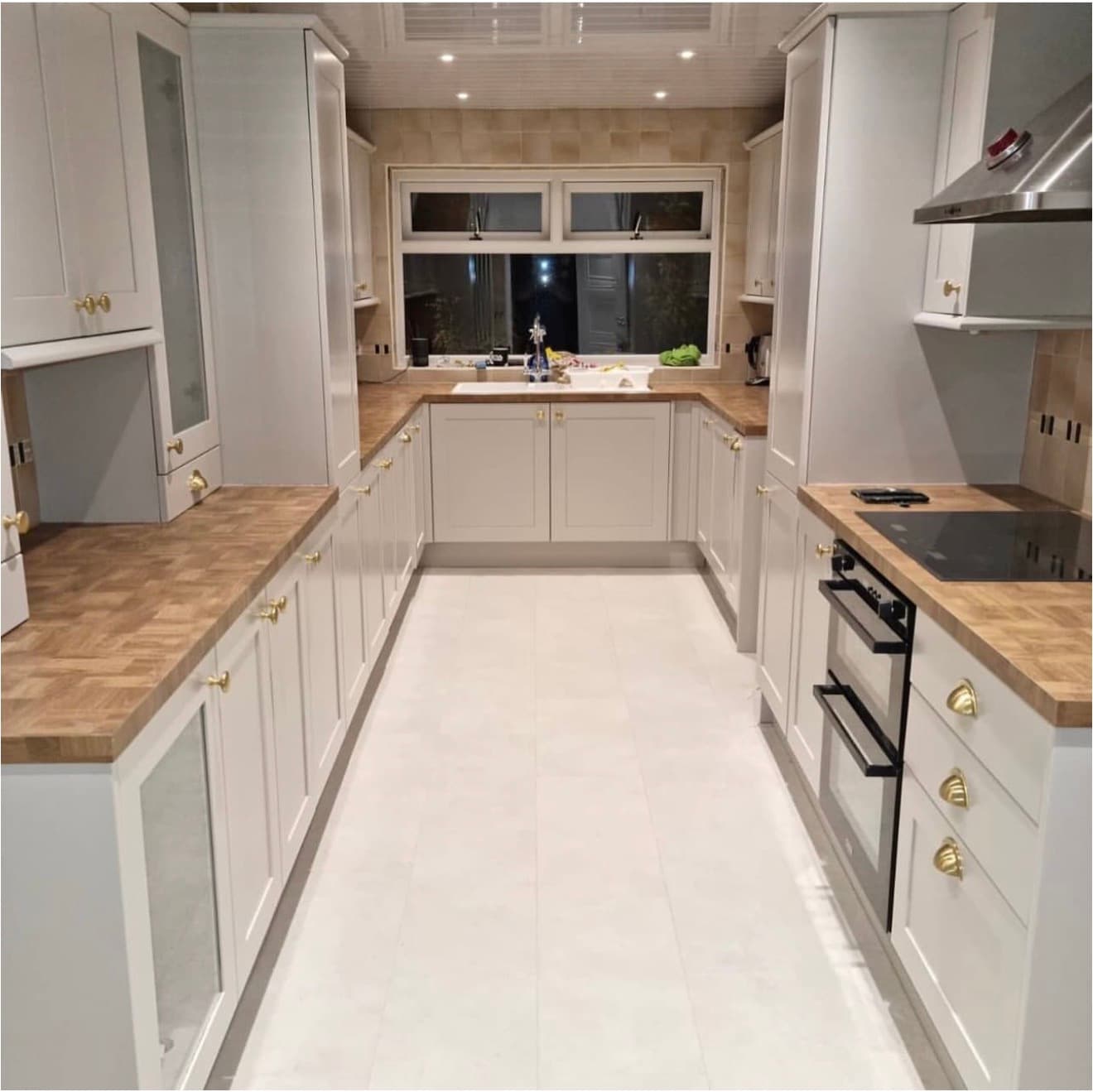
Most people typing "kitchen respray cost" into Google are really asking two things. What will push my quote up or down, and is my kitchen even a sensible candidate?
Those are the right questions. A respray quote is not built from a headline number. It is built from the kitchen in front of me: how many faces need finishing, what they are made of, what state they are in, and which route gets a durable result.
What actually affects a kitchen respray quote
The same few things come up on nearly every job. Homeowners tend to think about the size of the room. What matters first is how many individual faces need work and what they are made of.
1. Door and drawer count. A compact kitchen with a handful of doors is a different amount of labour from a large family kitchen with many doors, drawers, end panels and dress panels.
2. The material under the finish. Painted MDF, solid wood, melamine, laminate and vinyl-wrapped doors do not all need the same preparation. The substrate decides both suitability and process.
3. Current condition. Clean, stable doors are simpler than doors with peeling vinyl, swollen corners, knocks, old filler, heavy grease or a previous paint job that has failed.
4. Preparation. Some kitchens need a proper clean, degrease, sand and mask. Others also need repairs, filling and more workshop time before they are safe to spray. The price follows the work, time and effort the job needs.
5. The route. Some kitchens suit an in-situ respray. Others need the doors and drawer fronts removed and finished at our unit in Denton, especially when vinyl has to come off or there is heavier repair work.
6. Colour and detail. One colour is simpler than a two-tone kitchen, a contrast island, or a handle change that means filling old holes and drilling new ones.
7. Access. Where the kitchen is and how easily we can collect and return the doors can change how the job is planned.
The two routes most quotes are really deciding between
A lot of the difference between two quotes is the route, not the colour. That is why two kitchens that look similar in a phone photo can need different processes.
In-situ respray. Suits stable doors and cabinets where the existing finish is sound. The kitchen is masked off, cleaned, prepared, primed and sprayed in place. The quote moves with door count, condition, masking, colour changes and handle work.
Workshop route. Suits vinyl-wrapped, damaged or more demanding doors. Doors and drawer fronts come off, go back to Denton, and are stripped, repaired or filled as needed before they are finished. The quote also carries removal and refit, deeper preparation, vinyl stripping and repair time. We usually collect on a Monday and return on the Thursday, Friday or Saturday, depending on the week.
If a kitchen has peeling vinyl, swollen MDF edges, unstable old paint, or damage around the handles and sink run, the workshop route is normally the safer answer. Failed vinyl has to be stripped carefully so it does not tear the MDF underneath, and what is left is raw MDF plus old adhesive that has to be prepared properly before any finish goes on. That is labour, and it is why vinyl-wrapped kitchens cost more than a painted kitchen of the same size.
For the full difference between the two services, read the Standard vs Premium guide.
What to send if you want a faster, more accurate quote
Good photos do most of the work. They let me judge suitability, route and preparation without a week of back-and-forth.
- One wide photo of the full kitchen from each angle
- Close-ups of a few representative doors and drawers
- Any peeling vinyl, chips, swelling, cracks or old repairs
- A close-up of the sink run and cooker area
- A photo showing the current handles and hole positions
- The inside face or back of one door if you can
- A short note on colour direction, one colour or two, and when you want it done
If you know the kitchen brand or how the doors are built, include it. It helps, but clear photos matter more than brand names.
Send them through the quote form, email revitalizeresprays@gmail.com or call 07384 574225. I will look at the condition and tell you which route makes sense before you spend anything.
How to read a quote
My view is simple: compare the process and the result, not just the headline number. Cheap work usually means faster work, less preparation, a lower-grade finish or brush marks. So a useful quote should explain the route and the preparation, not feel like a guess.
Be careful with any quote that:
- asks nothing about door count, material or condition
- shows no interest in close-up photos of the problem areas
- makes no distinction between stable painted doors and failing vinyl doors
- says every surface can simply be sprayed in place, whatever its condition
The cheapest quote is not always the wrong quote. The vague quote usually is. Sprayed finishes fail when the prep is skipped, damaged doors are rushed, or the wrong route is chosen for the surface.
When a respray makes sense, and when it does not
A respray is the stronger option when the layout works, the carcasses are sound, the doors can be refinished, and the job is about appearance rather than redesign. Most kitchens are in better condition than their owners think. Often it is one or two doors that have gone, not the whole kitchen.
Replacement is the better call when the carcasses are badly water damaged, the layout no longer works, too many parts need rebuilding, or you want a different door style and storage plan. Paint does not fix a failed structure. If you are weighing that up, the respray versus new kitchen guide goes through it properly.
If you are not sure which side your kitchen falls on, that is exactly what the photos are for. A proper look saves people from both a poor respray and an unnecessary rip-out.
Frequently asked questions
What changes the price of a kitchen respray?
Door and drawer count, the door material, current condition, how much preparation is needed, whether the kitchen needs in-situ or workshop finishing, colour changes such as two-tone schemes, handle-hole work, and access.
Do vinyl-wrapped doors cost more to respray?
Usually, yes. Peeling or unstable vinyl means the workshop route: careful stripping, dealing with the old adhesive, and preparing the raw MDF underneath to the same standard as new raw MDF before the finish goes on.
When is replacement the better option?
When the carcasses are badly water damaged, the layout no longer works, several parts need rebuilding, or you want a completely different door style and storage plan.
What areas do you cover?
We work from Denton and cover Greater Manchester, Stockport, Cheshire and the wider North West, subject to job fit and the schedule that week.
Ready for a free quote?
Take our quiz at revitalizeresprays.co.uk/quote.
Or call Bryan directly on 07384 574225 — straight through to the workshop, no call centre, no chasing.
Revitalize Resprays — Unit 1a, 88-90 Wilton Street, Denton, Manchester M34 3NH. 25+ years wood-finishing experience, Google reviews from real local customers, as featured in The Times.
Related reading

Bryan Grime
Founder, Revitalize Resprays
More from the blog
Standard vs Premium Kitchen Respray: Which Is Right for You?
Compare Revitalize's Standard and Premium kitchen respray options: who each service is for, how the workshop process works, typical prices, durability and finish quality.
Kitchen ResprayingKitchen Respray or Replacement: Which Fits Your Kitchen?
Compare a kitchen respray with replacement by checking layout, storage, carcass condition, door damage, appliance changes and the finish you want.
Kitchen ResprayingVinyl-Wrapped Kitchens: Why They Peel and What Actually Fixes It (2026)
Vinyl-wrapped kitchen doors peel. Here's why it happens and why most quick fixes make it worse — from a Manchester sprayer.